01Glossary

Car Upholstery Glossary

27 terms

Short, plain explanations of the words you will hear in a car upholstery workshop – from types of leather to stitching and the parts of an interior. Missing a term? Just ask us.

A

Alcantara

Also:microfibre suede

Alcantara is a synthetic microfibre material with a soft, suede-like surface. The name is a trademark, but it is often used for similar materials too. It gives excellent grip and a sporty look, so it appears on steering wheels, seat inserts and headliners. It is more sensitive to skin oils and sweat and needs regular cleaning with a soft brush. With us, alcantara is available on request – please ask when you get in touch.

C

Channels

Also:pleats, fluted stitching, horizontal stitching

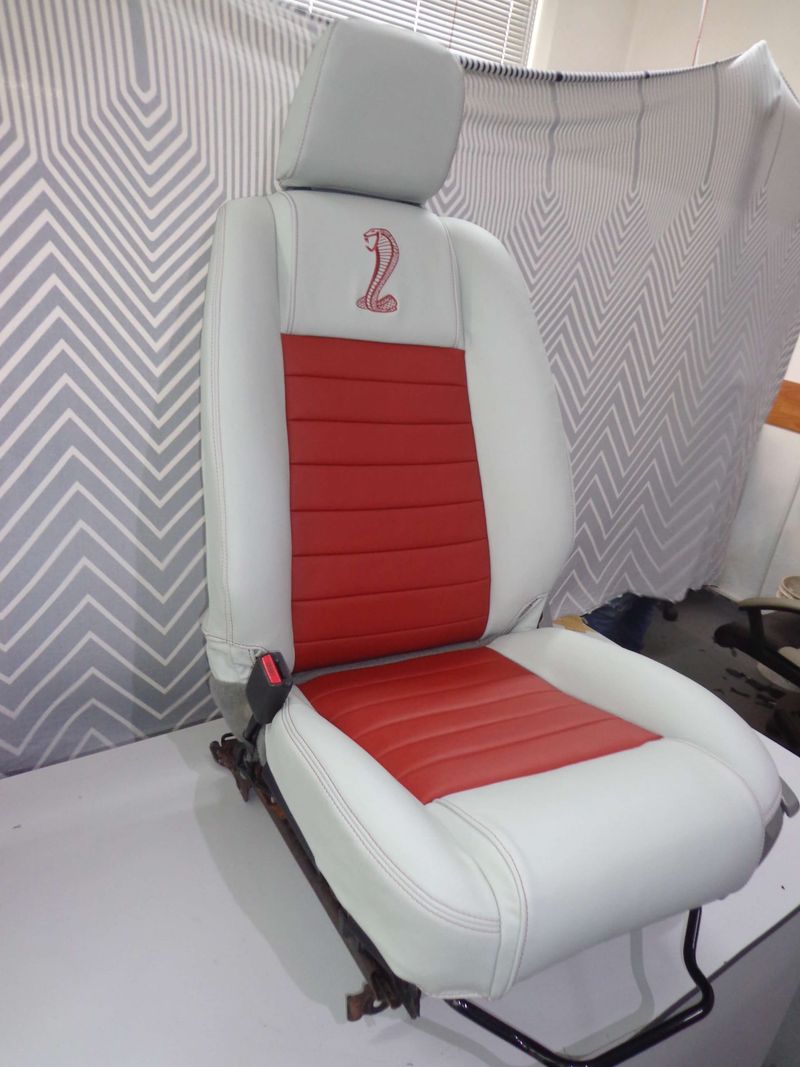
Channels are parallel lines of stitching that divide a seat insert into strips, running lengthways or across. Each strip is slightly raised, and the seams between them create a rhythmic relief. Channels give a sporty or retro look that is more restrained than diamond quilting, and they are often combined with perforation or contrast thread. Our online configurator lets you compare channels, diamonds, plain and perforated inserts.

Contrast stitching

Also:contrast thread, decorative stitching

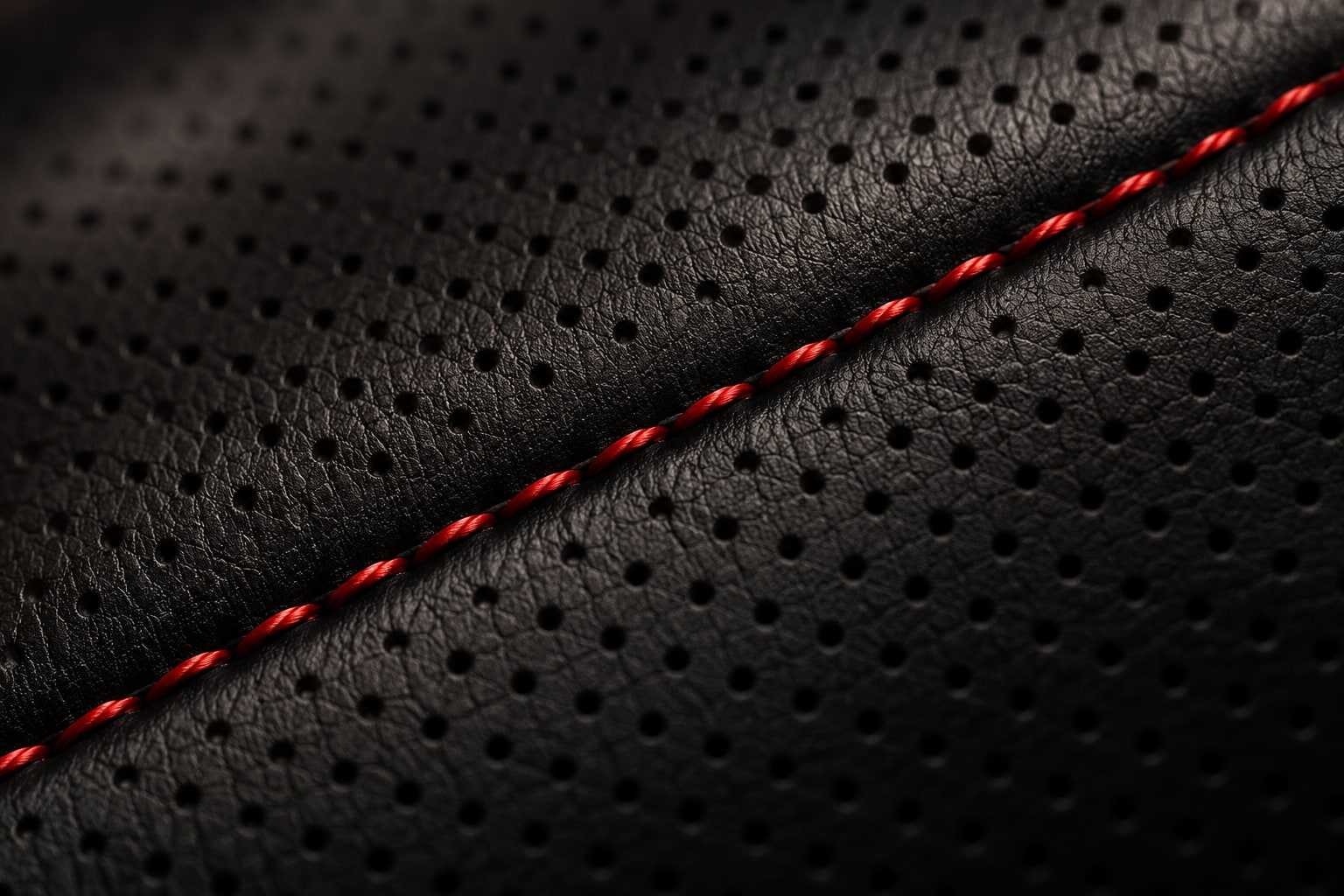
Contrast stitching is visible stitching in a thread colour that differs from the leather – for example red thread on black leather, as on the quilted seats of our Mercedes G-Class. It highlights the lines of the seats, steering wheel and dashboard and makes an interior more individual without changing the leather colour. The thread colour is usually repeated across the seats, wheel and gear boot so the interior looks coherent.

D

Diamond quilting

Also:quilting, diamond stitch

Quilting is a decorative stitching technique in which the leather is sewn together with a thin layer of foam in a repeating pattern – most often diamonds. This gives the surface a padded, three-dimensional look. Diamond quilting is typical of luxury interiors; we used it in cream and brown on the seats of a Bentley Continental GT. The pattern can be combined with contrast thread.

Double stitching

Also:twin stitching, double topstitch

Double stitching is decorative topstitching made of two parallel lines, one on each side of the seam between two panels. Besides looking neater, it keeps the seam allowances flat and reinforces the join, which is why it is common on seat bases and side bolsters. It can match the leather or contrast with it. The stitch is chosen together with the leather and thread, from samples.

E

Eco leather

Also:artificial leather, faux leather, synthetic leather

Eco leather is artificial leather – a synthetic coating, usually polyurethane or vinyl, on a textile backing that imitates the look of natural leather. It is more affordable, stain-resistant and easy to clean with a damp cloth and mild soap, with no conditioner needed. It breathes less than natural leather. It suits family and company cars, motorcycle seats and large areas such as door cards.

Embossed and embroidered logos

Also:embossing, embroidery

Embossing presses a logo or lettering into the leather as a relief, while embroidery stitches it in with thread. Both are most common on headrests and seat backs. When restoring, we keep the original embossed lettering. If you would like a new logo or lettering as part of a reupholstery, please ask when you get in touch what is possible for your interior.

F

Flat-bottom steering wheel

Also:D-shaped wheel

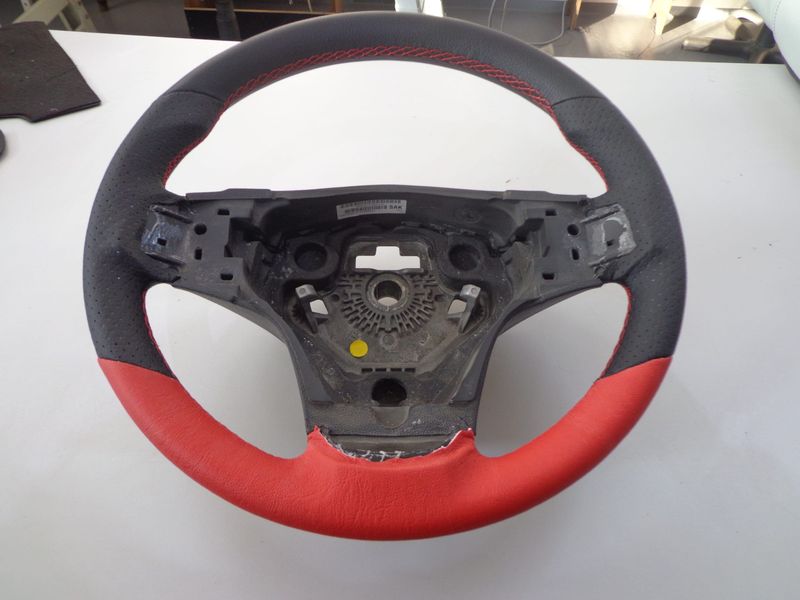
A flat-bottom steering wheel has a straight lower section instead of a full circle. It comes from sports cars: it leaves more room for your legs, makes getting in easier and underlines a sporty character. When re-trimming, the flat section and the transitions to it need more precise cutting. It is often combined with perforated grip zones, contrast stitching and a 12 o'clock marker.

G

Gear-shift boot

Also:gear boot, gaiter, shift boot

A gear-shift boot is the flexible leather cover around the gear lever, and on some cars around the handbrake too. It covers the mechanism and keeps dust out. Over time the leather cracks or tears in the folds. A new boot is sewn from natural or eco leather, often to match the steering wheel and with contrast stitching, to complete a refreshed interior.

H

Headliner fabric

Also:roof lining, headlining

Headliner fabric is the thin foam-backed textile that covers the rigid board of a car's roof lining. When the foam underneath breaks down with age and heat, the fabric comes loose and sags. The lasting fix is to remove the headliner, clean the board and bond new headliner fabric with a suitable adhesive. At our workshop this usually takes 3–5 working days.

L

Leather dyeing

Also:leather recolouring, leather painting

Leather dyeing means applying a special leather colourant to a cleaned and prepared surface, either to restore faded colour or to change the colour completely. The colour goes on in thin coats and is sealed with a top coat so it stays flexible and does not peel. The result depends above all on preparation: without deep cleaning, the colour will not bond for long.

Leather restoration

Also:leather repair, leather refurbishment

Leather restoration brings worn leather back without replacing it: the leather is deep-cleaned, cracks and scuffs are filled and sanded, and the colour is rebuilt in thin coats and sealed with a protective top coat. It is right when the leather is sound but has lost its looks. When restoring, we keep the original colour, grain and embossed lettering of the leather.

N

Nappa leather

Also:nappa

Nappa is a soft, smooth natural leather with a fine surface, finished so that it stays supple and pleasant to touch. In cars it is used mostly for steering wheels, seats and armrests, because it copes well with daily friction and is easy to clean. It can be smooth or perforated. For a steering wheel re-trim, nappa is the all-round choice, close to the factory finish of most cars.

Natural leather

Also:genuine leather, real leather

Natural leather is tanned animal hide used for seats, steering wheels, dashboards and armrests. It breathes, feels more pleasant in warm weather and, with proper care, lasts for years while developing a light natural sheen. It needs regular cleaning with a pH-neutral cleaner and conditioning every few months. We work with both natural and eco leather, and you can see samples at the workshop.

P

Perforated leather

Also:perforation

Perforated leather is natural or eco leather with many small holes. They improve grip, reduce sweating and let air through on ventilated seats. It is often combined with smooth leather: perforated inserts in the centre of a seat, or perforated grip zones on a steering wheel. Clean it with the product applied to a cloth, not directly to the leather, so no liquid gets into the holes.

Piping

Also:welting, beading

Piping is a thin strip of leather wrapped around a cord and sewn into the edges of seats and backrests. It defines their shape, protects the edge from wear and is often in a contrasting colour – for example light piping on a dark seat. Piping is typical of classic and luxury interiors. When a seat is reupholstered, it can be kept, changed to another colour or left out.

R

Reupholstery

Also:re-trim, re-covering

Reupholstery means replacing old upholstery with new: the old covering is removed and used to make patterns, the new parts are cut and sewn, and everything is refitted. It is how seats, steering wheels, dashboards, door cards and headliners are renewed – in the original look or with a new colour and design. It differs from restoration, where the original leather is kept.

S

Seat covers

Also:custom seat covers, made-to-measure seat covers

Seat covers fit over the original seat upholstery to protect it or change its look. Off-the-shelf universal covers rarely fit well, so made-to-measure covers are cut for the specific seats. They make sense when you want to keep the original seats in good condition, or when a full reupholstery is not in the budget.

Seat foam

Also:foam, padding

Seat foam is the polyurethane foam that forms the body of a car seat and also sits under the fabric of the headliner. Over the years it flattens, cracks or crumbles – the seat loses its shape and the headliner sags. When a seat is reupholstered, the foam is checked and restored where needed, especially on the side bolsters. On headliners, the crumbling foam is cleaned off completely.

Seat panel

Also:panel, insert

A panel is a separately cut piece of leather or fabric, and a seat cover is sewn from several of them – for example the seat base, the backrest or the side bolster. When only one panel is damaged, it can be replaced on its own with leather matched as closely as possible in colour and grain, instead of reupholstering the whole seat. This is the most common way to repair a torn leather seat.

1

12 o'clock marker

Also:centre stripe, top-centre marker

A 12 o'clock marker is a coloured leather stripe at the top of the steering wheel that shows where its centre is. It comes from motorsport, where it helps the driver sense the position of the wheels; in everyday cars it is mainly a decorative detail. It is usually in a contrasting colour – red, yellow or white – and is sewn in when the wheel is re-trimmed.

02 · Blog

Further reading

Short, honest answers about materials, repairs and caring for your interior.

All articles

Send a photo. Get a quote.

Send us a few photos and tell us what you'd like to change. The quote is free and comes with no obligation.